Showing posts with label patterns. Show all posts

Saturday, July 12, 2025

good quilty reads


 does it seem like i’m not getting much quilting done? maybe. i've definitely been quilting in spurts. and since i figured out about threading up the machines with the different colors of thread. i am once again jumping back and forth between projects. however, my quilting isn’t exactly accurately reflected in my blogging. i’ve broken up different parts of what’s been happening into smaller posts rather than having the posts too lengthy. i mean, i still talk a lot about the details, but i have been trying to make the posts themselves shorter. so i’m doing that and i’m also doing several posts at once and having them scheduled to post a few days apart. i think this makes it easier to read and it keeps my posting consistent without me having to tend to it all the time. so you could say i’ve been batching my posts themselves same way i batch my quilts. 

the other thing i've been doing - studying up on scrap quilts. i own dozens of quilt books (bibliophile + quilting fabriholic). i've actually been sorting and culling those as part of my sewing room overhaul project. i stopped buying (for the most part) a few years back because i already had so many. but recently, as part of my scrap studies, i've purchased a few older quilt books about scrap quilts. 


karen, of just get it done quilts, said as part of her scrap-busting process she has a few go-to scrap quilt patterns that she regularly uses and cuts scraps for. i thought that was a pretty smart idea and i'm on the hunt for scrap quilt patterns i like. that spurred me to look for some scrap quilt books. these are almost all used and only cost me a few dollars. i can donate any i don't find appealing or useful.

i've gotten to the point in quilting where i can look for inspiration in patterns that aren't already worked up in fabrics i like. i used to only buy books that i already liked the whole look of the quilts in it. but i can look past that now and focus on the patterns instead. so most of these books don't initially look like anything i would make, but i'm finding a lot of interesting ideas, tips, and patterns in them. i think i'll do a little report on each one (or at least the useful ones) as i go along.

so far, "quilter's scrap pantry" (which was not used but not expensive) has been my favorite. it's a tiny little gem of a book that's going to be so useful. but it's been a moment since i first read it, so i will revisit it and make a full report on precisely why i though it was good. 


not a scrap quilt book, but a real treasure - barbara brackman's encyclopedia of quilt patterns. i have an older edition as well as the newer 3rd edition, which is even better than the others and worth the investment. of course you could make these blocks with scraps and if i search, i'm bound to find blocks that would be good candidates for scrap quilts.


there is so much inspiration here! and i've been really surprised and intrigued with the names of many blocks. i've been loosley following #folksamplersewalong hosted by sara buscaglia of farm and folk. she's been compiling her own online encyclopedia of classic quilt blocks. her block picks for the sampler are coming from barbara brackman's book. it's a classic, for sure. if you're the type that enjoys coming up with your own quilt patterns, you'll find lots of ideas in this book. or if you just enjoy a bit of quilt history, that's here, too.

what older or off-beat quilt books do you have in your library or enjoy despite their dubious or less-than-flashy appearance?

Monday, February 18, 2019

chevron blocks


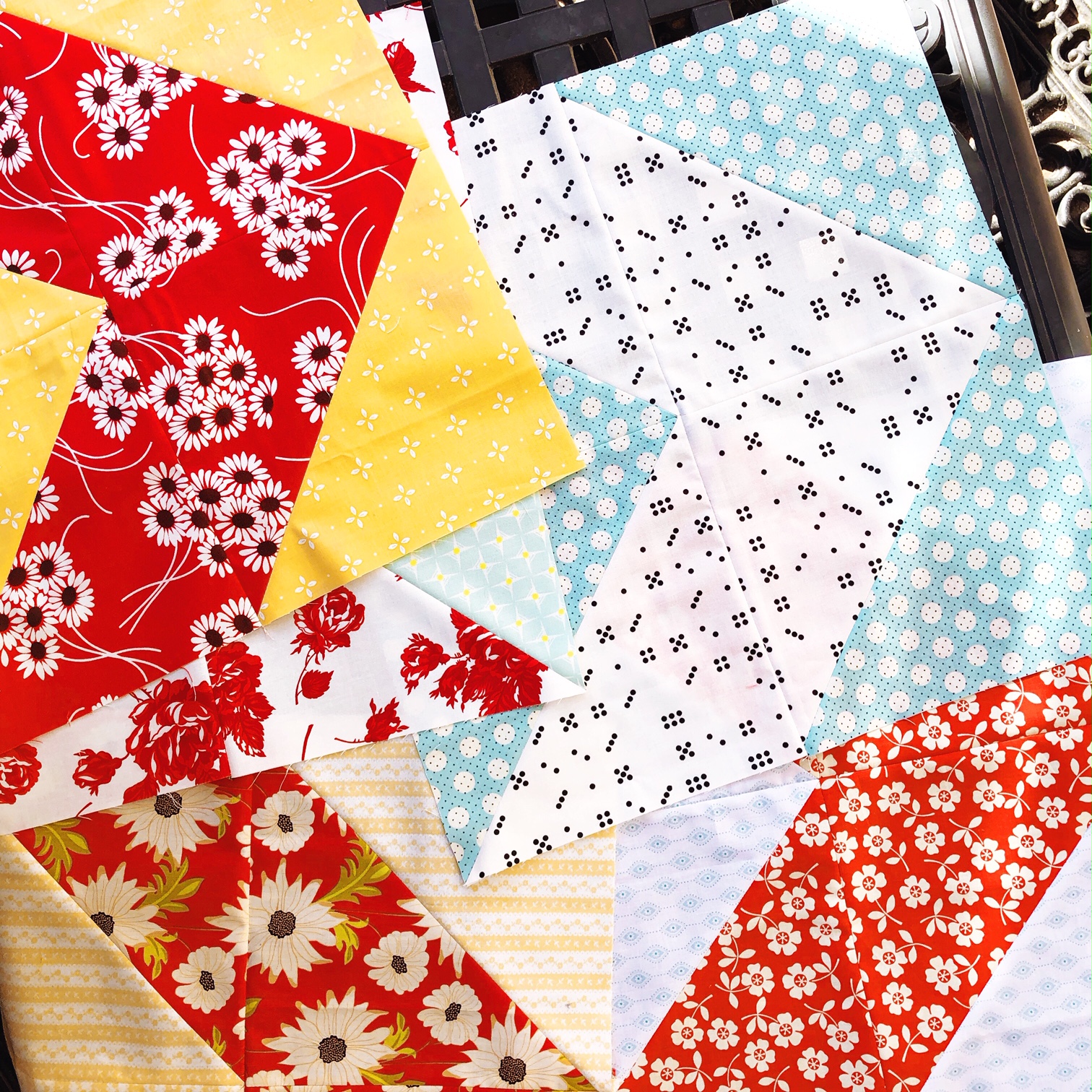
chevrons are so, i don't know, five years ago, right? but they are kind of classic, too. especially in a formation where they aren't creating a solid zig-zag pattern across the quilt.

they are also an incredibly easy block make. this quilt top (that i finally got around to completing after making the first 2 blocks about 4 years ago) went really, really fast.


if you are an experienced quilter, here's the quick explanation of how to make a 16" chevron block:

1. cut 2 - 9" squares of each of 2 fabrics in your block (4 total)
2. make 4 hsts from the blocks and trim to 8.5"
3. arrange the hsts in a chevron formation and join together

it's so easy.

the above quilt top, which measures 64" x 80", is composed of 20 chevron blocks in a 4 column by 5 row grid.


fabric requirements:

20 fat or skinny quarters (makes two of each block, 10 different styles total)
or
40 fat or skinny quarters (makes one of each block, 20 unique blocks)
or
2 - 9" sqs each of 40 fabrics (makes one of each block, 20 unique blocks)
or
2 layer cakes (makes one of each block, 20 unique blocks. layer cakes are 10" squares, so you will either make larger blocks or trim each piece down to 9" to start.)

as i was making a set of blocks, i decided to photograph the process with my phone. the pictures are not pretty or of high, professional quality but if you need more detailed instructions and photos to guide you along the way, here you are:

cut 2 - 9" squares of both fabrics for the block: your chevron and your background
(i had already sewn the squares together when i decided to photograph the process, so ignore the seams for a bit.)

my two fabrics, each cut into 2 - 9" squares and made into pairs of 1 sq each fabric.

place the fabrics in pairs, one of each per pair. put them right sides together.

on the backside of one square, draw a diagonal line from one corner to the opposite corner with a pencil (or your choice of marking tool). i generally do this on the lighter fabric so it's easier to see.

using the pencil mark as your guide, sew a 1/4" seam on each side of the pencil mark, diagonally from corner to corner.


after i sew the seams, i like to give a quick press to the fabrics to smooth them out before cutting. there is usually a tiny bit of rippling no matter what foot or what speed i use, so i like to do the quick press. above, the top block has been pressed and the bottom one has not.

with a ruler lined up along the diagonal marking line, cut the squares in half diagonally between the set of seams.

you can see the seam is a scant 1/4" off the cut.

press the seam open to both sides.

with the hst blocks you get a lot of bulk where all the intersecting seams meet, which can make the quilting difficult, as well as produce the annoying little bulges felt in the quilt when it's finished. for this reason, i choose to press these seams open rather than to the side.

also, i like to use the "floppy book method" to help my seams lie flat.

as soon as i've opened the seams, i will lay an old phone book or a couple paperback quilting books on top of the block and let it stay for at least 30 seconds or so. i let it sit while i'm working on the next block or until i'm ready to trim them all.

when all four blocks are pressed, trim them to 8.5".

this is a step that helps with accuracy, particularity because we have slightly overcut the size of squares needed to produce the hst.

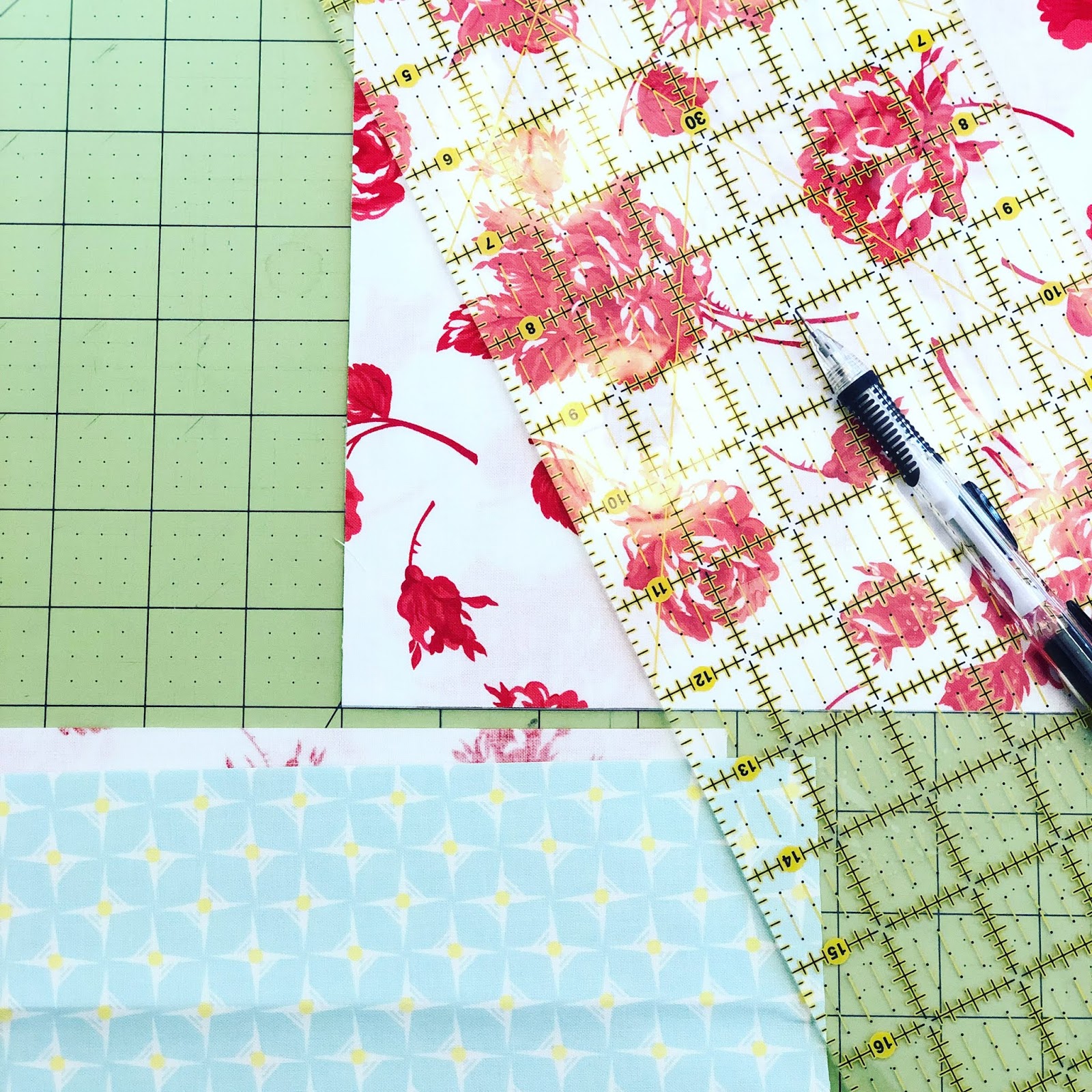
i use my 9.5" square ruler for trimming these blocks. any sq ruler 8.5" or larger would work. if you don't have any large sq rulers, you could also just measure using whichever ruler you use to make your large cuts (presumably 6" x 24" or some such), you'll just not be able to do it in the manner shown here.

place the sq ruler on top of the quilt block so that the diagonal line on the ruler is lined up with the diagonal seam of the block, and the corner opposite where you want to cut is near the 8.5" mark lines.

also check all the perimeter lines of the block to assure that you have fabric up to or past each of these lines. you might have to slide the block along the diagonal line a bit or make some other adjustments.

from where i'm standing, i'm going to make a cut along the top of the ruler, and also along the left side, past my hand. my cutting table is small enough that i can maneuver around it in this manner without being at an awkward angle for cuts. you can see that i have the bottom and right sides of the block aligned with the 8.5" lines and there is a little fabric poking out on the opposite two sides for me to trim off.

when you have made those two trims, either move the block around or flip the ruler around to the opposite corner. once again, line everything up and trim. my cutting space allows me to just move to the oppsosite side of the table to cut the right and bottom sides, but you may need to move the block under the ruler instead so that you can comfortably make the cuts.

or, you may need to adjust and turn the block each time you make the 4 different cuts. whatever your space requires.


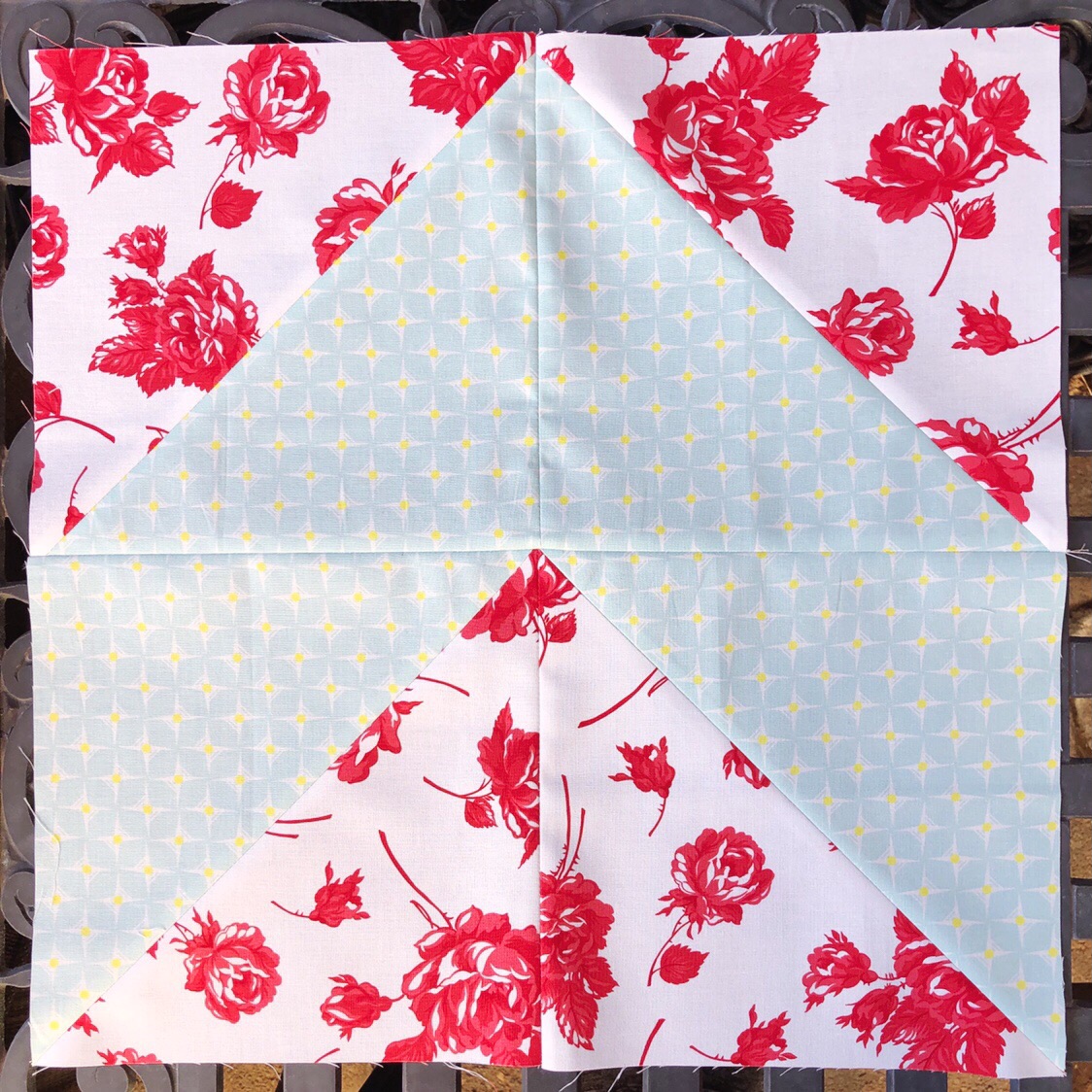
when all 4 blocks are trimmed up, place them in a chevron configuration. if you look at it, this is actually two flying geese blocks with the fabrics opposite of each other.

the fabric you want to be your chevron should be on the inside forming the triangle (geese) on the top block and your background fabrics form the triangle (geese) on the lower block.


put your blocks right sides together and lined up on all edges, then sew a 1/4" seam on the right side.

for the first set of blocks, you will be sewing along the seam where the chevron fabrics are touching each other and the diagonal line moves away to the left. the next pairing will look exactly the opposite of this with the background fabrics touching instead.

i chain piece the blocks, meaning i just put the next block in and sew it without cutting the threads in between. if you have all your blocks precut and trimmed because you are working in batches, you could easily chain piece the whole top this way at once.

once the two component parts are sewn, press the seams open to both sides.

lay the block out again so you can see your chevron in the configuration you desire, then flip either the top down or the bottom up so that you have right sides of fabric facing each other.


line the two pieces up at the center seams and pin through the seam.

i'm not much of a pinner, as you can tell since i haven't pinned yet. but i do pin at this juncture to try to get my points just right.

sew the center seam together.

press open the center seam as well.

i didn't photograph it, but i do use the "floppy book method" after each pressing. also, after i have pressed open on the back, i flip the block over and press from the front, then lay the books on the block.


now you have a completed 16" chevron block.

(of course, when you have sewn it together but not with the other blocks, it measures 16.5". )

for the quilt i am making, i made 20 blocks, laid out in a 4 x 5 block grid.


there is a trick to getting your directional prints to match in a chevron block. you can see how to do that here. and when the quilt is complete, i'll talk more about my fabric choices and pairings.

Wednesday, March 8, 2017

building a c


 quite often when i'm in the middle of a project, i'll take photos of the process as i go, with the intention of making a blog post out of it at some point. and sometimes, much later, i find those photos when i'm looking for something else. such was the case with these photos of when i decided to make letters to spell my son's name for his blue and orange wonky quilt using the letter patterns in denyse schmidt's "proverbial quilt."

the letters could either be patchwork pieced or paper pieced. i chose to trace the pattern and patchwork it together. you can watch my letter "c" quickly come together.


there are 4 pieces to letter "c." i cut apart the paper pattern, then selected a fabric scrap for each component. when i cut the fabric, i added in a 1/4" seam allowance on all sides by pinning the paper the the fabric and using a ruler to gauge 1/4" outside the pattern piece. all the letters in this patter have all straight lines to each piece, so this is quite easy to do.


next i sewed  pieces 2 and 3, the top and bottom segments of the "c," to the center background piece 1. once pressed, there was only one more bit.


piece 4, the long left side of "c" was last to go on.


setting the seam.


then pressing open.


and there you have a letter "c."

this process was very quick and quite enjoyable! i do plan on doing an entire quilt of a favorite quote someday.


next time, i'll just need to make sure i can see the pins so i don't accidentally sew one into the letter.

this quilt is now in the binding phase, by the way. it should be a finish quite shortly!

Monday, August 31, 2015

"cinched" pattern tutorial


this is a simple strip quilt pattern which utilizes a jelly roll and a bit of extra yardage for an accent strip and block across the upper portion of the quilt. it comes together quickly and easily, with a few opportunities to embellish the design for more detail.

in this tutorial, i will give basic instructions for the pattern. for more detailed instructions, please refer to the links to each section of assembly.


fabric requirements

i'm starting with a generous amount of yardage partly because i already have it in my stash and partly because i simply like to work that way. generally i need room for error and i happen to adore scraps, so leftovers are quite welcome. 
  • one jelly roll (or 45 - 2.5" wide x wof  strips, see further options below)
  • fabric a - 1/2 yd for accent block and backing strip a (could be done with 1/4 yd or fat quarter if adjusting measurements slightly - see section on accent block)
  • fabric b - 2/3 yd for accent strip and backing strip b
  • fabric c - 1/2 yd for extra strips and backing strip c
  • fabric d - the equivalent of one jelly strip for strip joining squares (if using)
  • optional fabric e - 1/3 yd for accent block
  • 1/2 yd binding fabric
  • 3 1/4 yds backing fabric, 4 1/4 yd if using a directional print
it's a pretty small list. if you want more variety in the strips, which i do, you can use additional coordinating pieces. 

* note - 1/4" seams used through out and all measurements are for "cut" (seam allowance included) not "final" unless otherwise noted.

make the strip sections

cut the selvages off all jelly roll strips. (for more detailed instructions on preparing the strips, see cinched pattern, part one.)

select 30 jelly strips to be cut in half and used for the upper section. (set the other 10 strips and the 30 half strips aside for the lower section.) arrange these 30 half strips in a row for the upper section. (for a detailed discussion of strip selection and construction options, see cinched pattern, part one.)


layout the lower section with 30 full strips in a row. these full strips include the 10 remaining jelly strips from the jelly roll, your 5 additional full strips cut from fabric c yardage, and 15 full pieced strips constructed from the leftover halves from the upper section.


you can either simply piece the leftover half strips or . . .


you can make pieced strips that include small 2.5" x 2.5" cut joining blocks, for more interest. i did this, varying the placement height of the joining blocks in the strips, and also using three pieced sections and two blocks for some of the strips. (see cinched part one for a discussion on these joining options.)

cut the accent strip and accent block pieces from fabric b and e.

the accent block can be a simple 10.5" square of one feature fabric e or you can create any quilt block of your choice 10.5" in size. in this quilt, i chose to make a courthouse steps block. (for a discussion of block options and how i made my accent block, see cinched pattern, part two.)

join your accent strip pieces to your accent block to make the middle accent strip of the quilt top. there is a little extra length to this piece as cut so you can play with placement of where you want the accent block to fall.

lay all the pieces out either on a design wall, bed, or floor to check the placement of your strips in the upper and lower sections with the accent strip in between them so you can see how you like your layout.

join the strips in each sections together to create two panels, an upper panel and a lower panel. (for more details on joining the sections together, see cinched pattern, part three.)

join the three panels together to complete your quilt top, which is now approximately 70" h x 60"w, once you square it off. (i used 31 strips so my top is actually 62"w.)

next, create a backing. i like to piece my backings and used a three-strip accent stripe for the back of this quilt. (for directions on making this backing, see three strip accent stripe pieced backing.)


sandwich, baste, and quilt.


for the "out on a limb" version of this quilt, i did a simple echo quilt of all the seams. this resulted in lots of straight lines and a flatter, less-crinkly texture.


for "bloom where you are planted," i used a loopy figure eight quilting pattern, which ran along the strips. this quilt has glorious crinkle texture to it, if that is your preference.


in the accent strip, i stipple quilted for some contrast and added interest. the accent block also had some unique quilting in it's sections. (for a discussion of my quilting choices, see "loops and crinkles.")

"bloom" is bound in some lovely olive lottie dot from heather bailey's "lottie da" collection

now you just need to bind your quilt and you are ready to wash and snuggle!

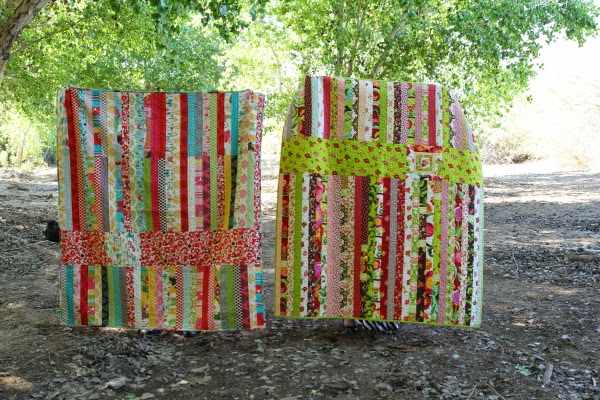
i've completed two versions of this quilt so far, and have the fabric for a third set aside. "limb" lives on our living room couch and is regularly used and greatly loved, despite all it's imperfections, which i don't really notice any more. "bloom" was gifted to my dear friend and quilting buddy, jill, who has moved away. despite the fact that my 16 yr old photographer did not notice "limb" was upside down, you can see the two versions of the quilt here together and how the slight variations affect the look of the quilt.

i've greatly enjoyed this pattern, which is so simple and satisfying. having designed something myself, especially as a new quilter, is very gratifying, indeed. giving the gift of love made tangible in the form of a cuddly quilt is the best part of all.

i hope you enjoy this pattern and would love to see any version of it you create.

happy quilting!

the detailed steps for this tutorial are spread over 6 posts i wrote as i made the "bloom" quilt and worked on the pattern. find the others here:

cinched part one - fabric requirements and strip preparation
cinched part two - the accent strip and block, modifications from the first quilt, joining blocks for the long strips
cinched part three - joining your strips and sections to assemble your top
the three-strip accent stripe pieced backing - how to make the backing
loops and crinkles - quilting choices for "bloom where you are planted"
cinched part four - quilting, binding, and gifting

linking up with friday finishes at crazy mom quilts